20 questions to answer before a national retail pitch.
Retail readiness means being able to support the order and the reorder. Review the product story, retailer economics, inventory funding, compliance, and launch ownership before the buyer meeting. Use this checklist to identify missing evidence and assign the work, then decide which gaps must close before making a commitment.
The real test is not whether a buyer likes the product. It's whether the business can support the order, protect margin, and earn the reorder.
Economics
- What gross margin does the retailer receive at the expected shelf price?
- What is your contribution margin after freight, allowances, commissions, returns, markdowns, and promotions?
- How much working capital is required before the first meaningful payment arrives?
- What happens to margin if the retailer asks for a launch discount or lower opening price?
- What is the downside case if sell-through lands 30% below plan?
Assortment and buyer story
- Why does this product belong at this retailer for this customer?
- Which SKUs earn the first placement, and why?
- Does the price architecture work beside the likely shelf competitors?
- What evidence shows the item will move beyond DTC audiences?
- Can the story be understood in ten seconds at shelf or online?
Operations
- Are packaging, barcodes, case packs, dimensions, and labels retailer-compliant?
- Who owns routing-guide compliance and chargeback prevention?
- Can inventory and production support opening orders plus replenishment?
- What service level can you maintain during a promotion or viral spike?
- How quickly can you isolate and correct defects, shortages, or late shipments?
Launch and sell-through
- Who owns the launch calendar from item setup through the first 90 days?
- What marketing will create demand at the retailer, not just on your own site?
- How will weekly sell-through, inventory, returns, and store-level gaps be reviewed?
- What is the intervention plan if velocity misses expectations?
- What result must be true for the retailer to reorder or expand doors?
If several answers are assumptions, pause before the pitch.
The $2,500 Retail Readiness Review pressure-tests these questions against your actual brand, target retailer, economics, and timing.
Request a review →What makes a DTC brand retail ready?
Retail readiness means the business can support the account it is pursuing: the economics, assortment, buyer evidence, inventory, compliance and launch ownership all fit the same plan. A complete application or strong online sales history alone does not establish that readiness.
Prepare an account-specific readiness file
- Economics: model landed cost, wholesale revenue, retailer margin, support, freight, returns, deductions and working capital. Link every assumption to a proposed term or a clearly labeled planning case.
- Assortment: explain which items and price points belong in the initial test and why. Every color, size or bundle adds an inventory commitment.
- Evidence: show the shopper, use case and geographic demand behind the pitch. Separate DTC actuals from the store forecast.
- Operations: verify packaging, identifiers, carton labels, routing, replenishment and reporting against the current account requirements.
- Ownership: name who approves the forecast, funds demand support, manages deductions and responds when performance falls behind.
Make the final output a go, fix or wait decision with owners and dates. Use the Retail Readiness Scorecard to locate the gaps, then read how buyers evaluate new products and the wholesale price stack.
Before the line review
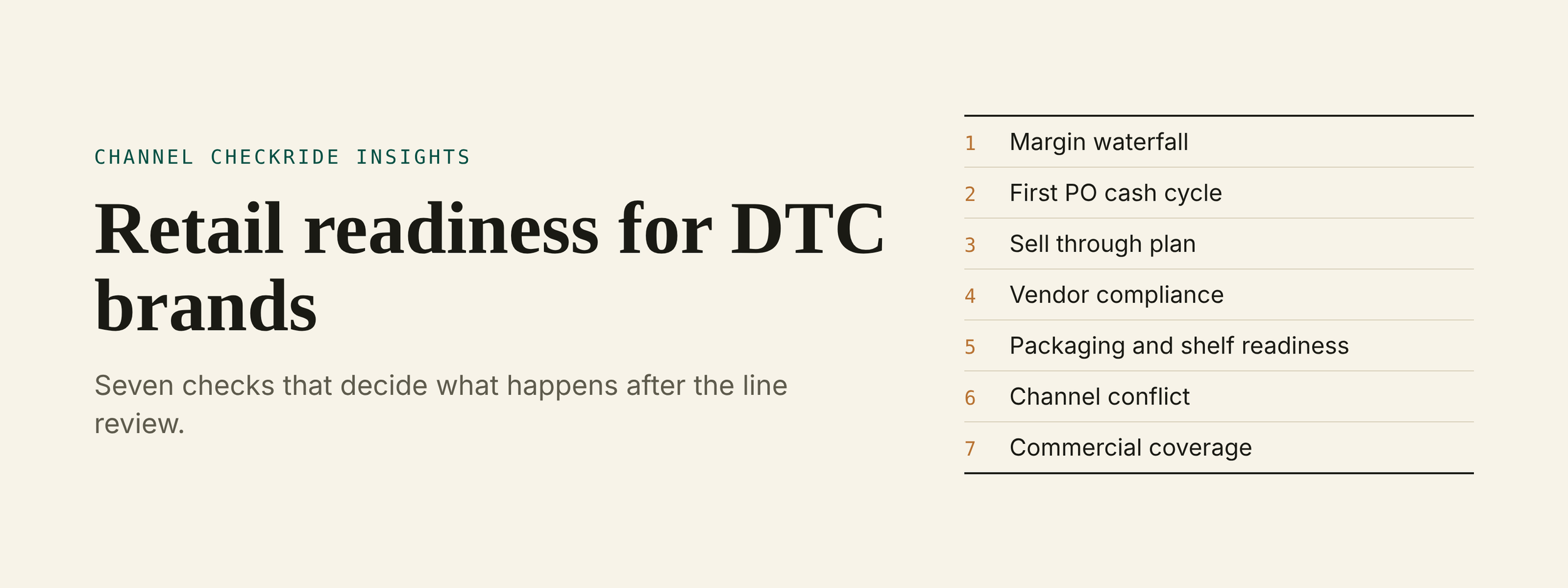
The 7 checks for DTC brands before the line review
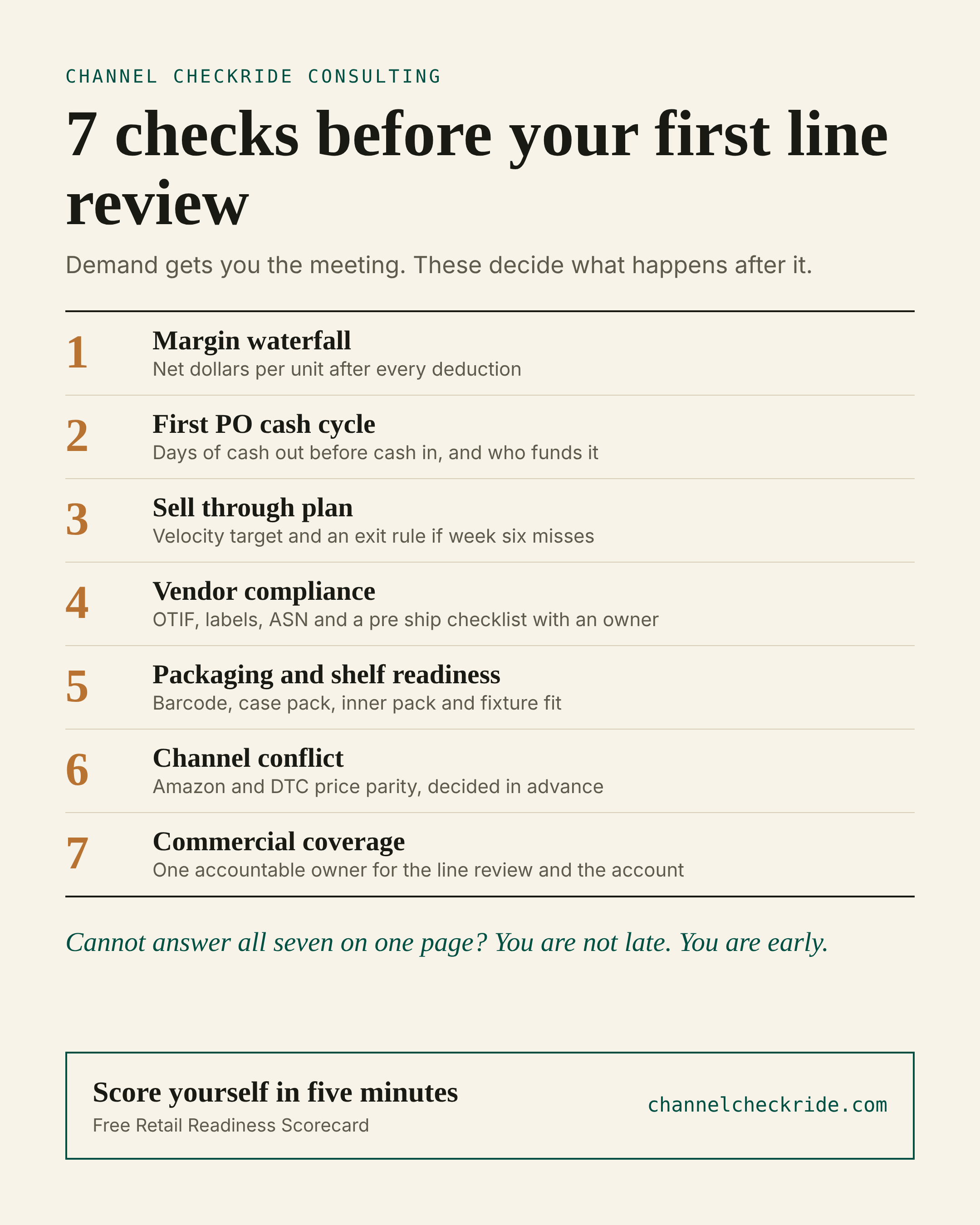
The questions above tell you where you stand. The seven checks below turn those answers into the work a buyer will expect to see done. Demand gets you the meeting. These checks decide whether the PO makes money after it.
Run them in order. The first two are math. The last five are operating decisions. If one fails on paper, fix it before you ask for the meeting. If you are still mapping the path to a first buyer, start with how to get your product into retail stores, then come back here.
- Margin waterfall from shelf price to net dollars per unit
- Terms and cash cycle on the first PO
- Sell through plan with weekly velocity targets
- Vendor compliance: OTIF, ASN, labels, routing
- Packaging and shelf readiness
- Channel conflict: Amazon, DTC and price parity
- Commercial coverage: who runs the line review
1. Margin waterfall from shelf price to net dollars
Start with the shelf price and walk down. Retailer margin comes first. Then markdown or promo allowances, defective allowances, a chargeback reserve, freight to the distribution center, and finally your landed product cost.
A $40.00 shelf price with a 40 percent retailer margin gives a $24.00 wholesale price. Subtract a $1.20 markdown allowance, a $0.48 defective allowance, a $0.36 chargeback reserve and $1.00 freight, and net revenue is $20.96. Take out $9.00 of landed product cost and contribution is $11.96 per unit, about 30 cents on the shelf dollar.
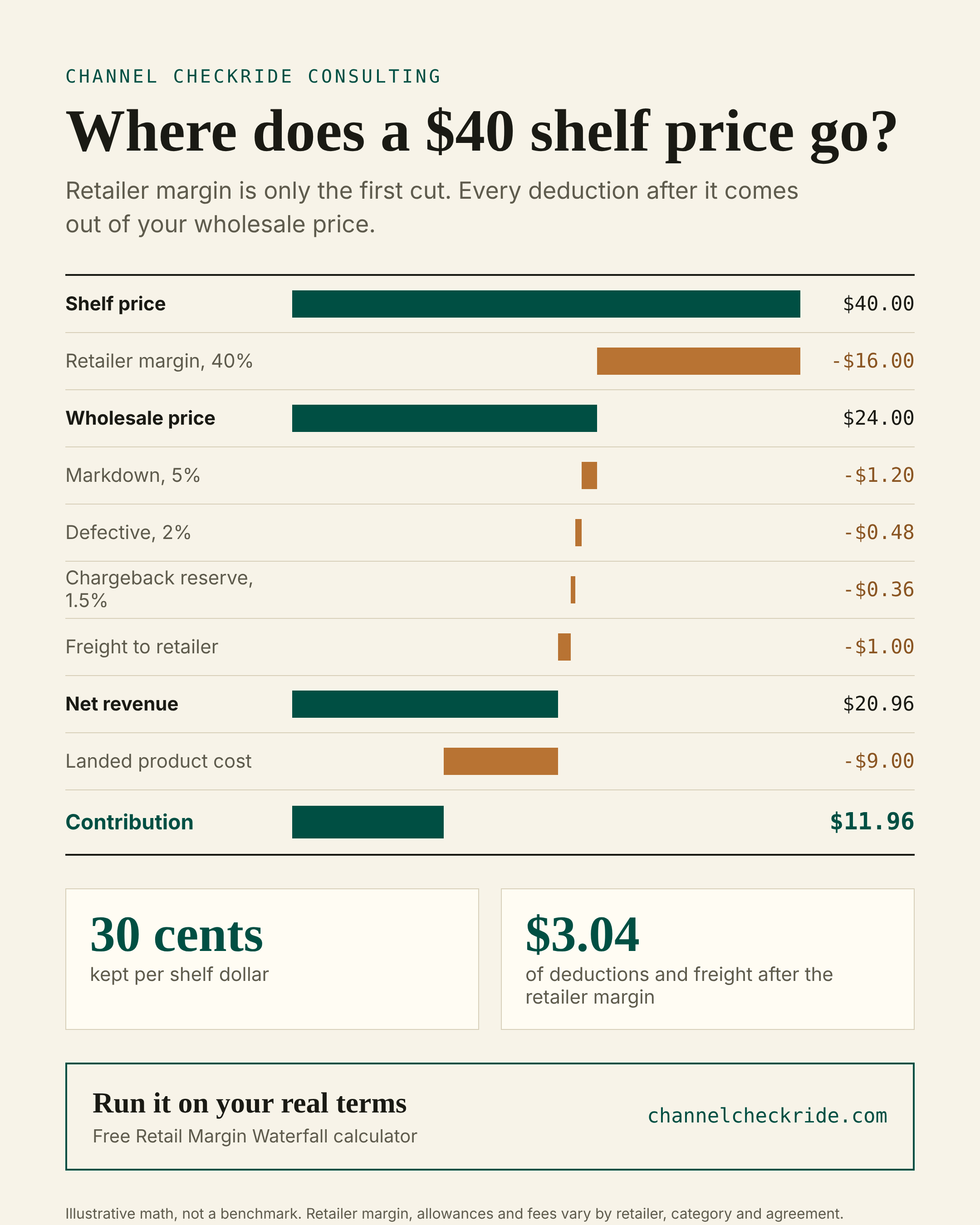
If that contribution is not one you can live with, fix the price ladder or the cost before the meeting, not after the PO.
Build yours with the retail margin waterfall. For the underlying trade math, read the wholesale pricing formula.
2. Terms and the first PO cash cycle
Retail pays late. You pay your factory early. The gap is your financing problem.
Cash gap days = supplier deposit to ship date + transit and check in + retailer payment terms
A 5,000 unit order at $24 wholesale is a $120,000 invoice. The deposit goes to the supplier on day 0, the balance, freight and duty around day 45, and the goods ship to the retailer around day 87. Net 60 payment arrives on day 154, and peak cash out along the way is $52,500. After 4 percent expected deductions, the retailer pays $115,200.
In a bad month, with payment 20 days late and deductions at 9 percent, you wait until day 174 and receive $109,200.
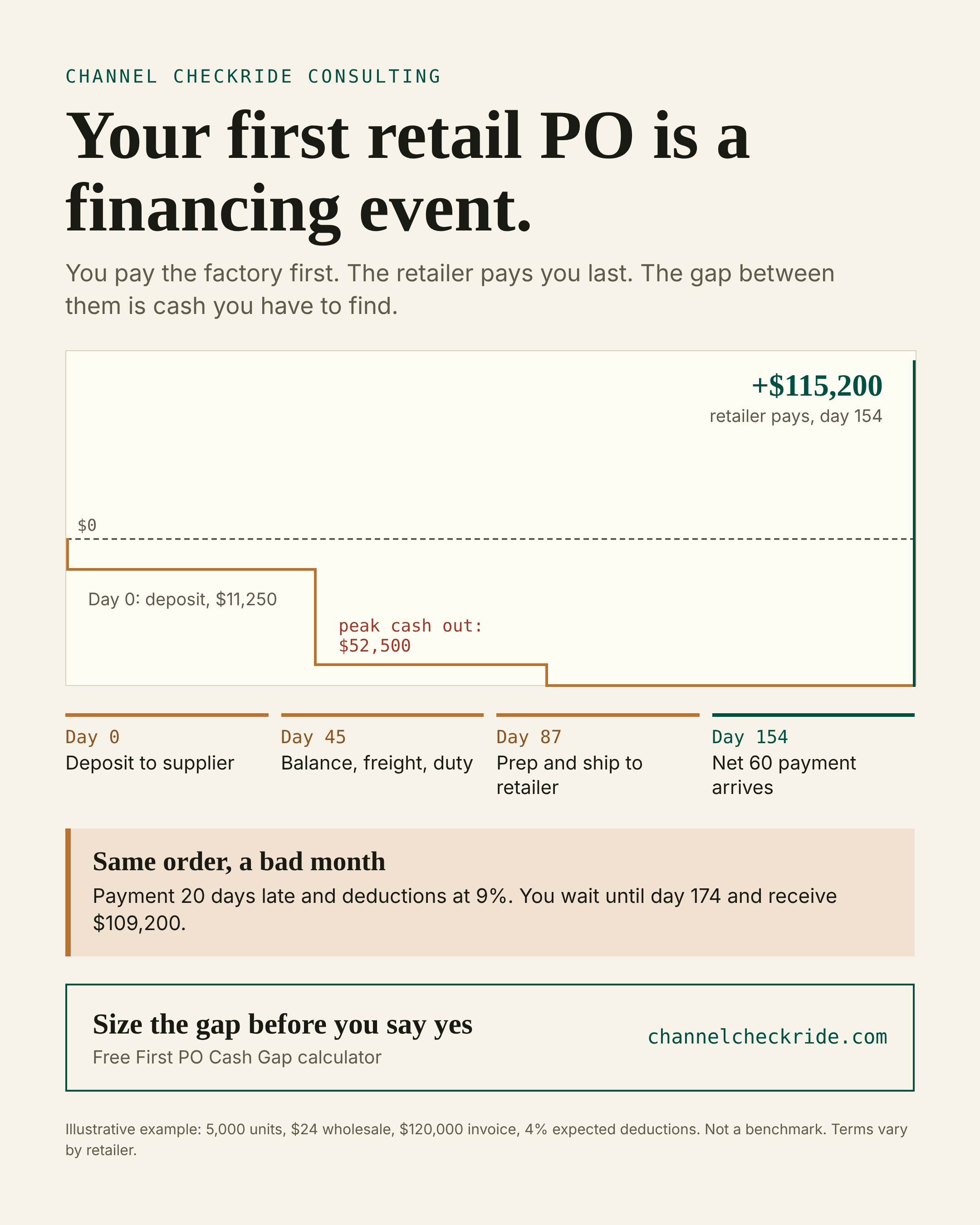
Your first PO is not only a win. It is a financing event. Know the number, and know how you will fund it, before you accept the order.
Calculate your first PO cash gap, including late payment and heavy deduction cases.
3. Sell through plan and weekly velocity
Buyers do not buy potential. They buy a plan. Bring a target for units per store per week, weeks of supply on hand, and what you will do if the SKU misses by week six. Define the trigger for a markdown, a price rollback or a pull. A brand that shows its exit rule looks like a partner.
4. Vendor compliance: OTIF, ASN, labels, routing
OTIF means on time and in full. Retailers measure it and fine you when you miss. Late advance ship notices, wrong labels, broken routing and short shipments each turn into a deduction. Budget compliance as a line item with an owner, and build a pre ship checklist that covers:
- Carton labels that match the retailer's routing guide
- ASN accuracy against what is actually on the truck
- Delivery appointment times
- Pallet configuration and case counts
5. Packaging and shelf readiness
DTC packaging is built to be opened at a kitchen table. Retail packaging has to survive freight, hang or stack on a fixture, scan at the register and sell in seconds. Check barcodes, case pack, inner pack, shelf ready or display ready options and fixture fit. A great product in the wrong carton costs you a reset.
6. Channel conflict: Amazon, DTC and price parity
A buyer will check your site and your Amazon listing. If your own price undercuts theirs, expect a hard conversation or a lost slot. Decide before the meeting: a retail exclusive SKU or bundle, a minimum advertised price policy, or a channel specific pack size. Pick one and be ready to defend it.
7. Commercial coverage: who runs the line review
Someone has to build the deck, answer buyer follow ups, run promotions and watch weekly data. In a founder led brand, that is often the founder, who is also running everything else. Decide who owns it, whether a new hire, a rep group or a fractional lead. A buyer can tell when nobody does.
Retail readiness scorecard
Score each check honestly. Ready means written down, not assumed.
- Margin waterfall. Ready: net dollars per unit known after every deduction. Not ready: only the wholesale price is known.
- Cash cycle. Ready: cash gap in days, with a funding plan. Not ready: funding assumed.
- Sell through plan. Ready: velocity target and exit rule written. Not ready: "it sells great online."
- Compliance. Ready: pre ship checklist and a named owner. Not ready: the first chargeback is the lesson.
- Packaging. Ready: case pack, barcode and fixture fit confirmed. Not ready: packaging unchanged from DTC.
- Channel conflict. Ready: price parity policy decided. Not ready: surprises in the meeting.
- Coverage. Ready: one accountable owner. Not ready: the founder does everything.
Want it scored for you? The retail readiness scorecard takes about five minutes and ranks your weakest checks first.
Frequently asked questions
How much margin does a retailer take?
It varies by retailer and category. Ask for the margin target in the first conversation and build the waterfall from the actual number, not a rule of thumb.
What is OTIF and why does it matter?
OTIF is on time in full. Missing it triggers fines and can put your vendor standing at risk.
When should a DTC brand approach a buyer?
After the seven checks pass on paper. Hiring a retail or sales lead is often the sign the brand is hitting this wall.
How long does it take to get ready?
It depends on which checks fail. Margin and cash are analysis and can move quickly. Packaging changes and a new commercial owner take longer. Start with the checks that block the conversation.
Find the gaps before the buyer does
If you cannot fill in the scorecard above in one sitting, a Retail Readiness Review is the fastest way to find the gaps. You get the waterfall, the cash cycle, the compliance checklist and a ranked fix list before your next buyer conversation.
Not sure where you stand yet? Start with the free scorecard and see which checks need work first.